
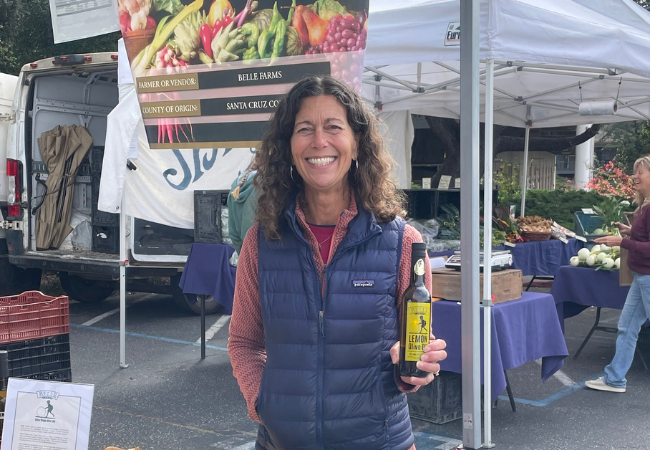
Three consecutive years of international Gold Medals are something to celebrate. But for Belle Farms’ Marguerite Remde, the truest measure of a good olive oil is still found much closer to home—in the customers who return year after year.
There is something wonderfully fitting about the way Marguerite talks about Belle Farms’ latest accomplishment.
In 2026, both the farm’s Estate Grown Tuscan Olive Oil and Lemon Olive Oil earned Gold Medals at the prestigious Athena International Olive Oil Competition—marking the third consecutive year Belle Farms has received gold-medal recognition.
Marguerite is delighted, of course. But she also puts the honor into perspective.
“While I have always said that I am most concerned about what my customers think of our products, it is very validating—and exciting—to know that what we are doing stands up on an international level.”
For a small California farm to be recognized alongside producers from some of the world’s most celebrated olive-growing regions is no small achievement.
“It is very validating to know that as a small farm, we can ‘hold our own’ in this growing industry that includes some very big players!” she says.
Yet spend a little time talking with Marguerite and it becomes clear that medals are only one part of the Belle Farms story.
The larger story is about farming, patience, close attention to the fruit—and more than two decades spent learning what olives will and will not allow you to control.
An Orchard Begins With a Dream
Belle Farms’ olive story began simply enough.
Marguerite’s husband was born and raised in Watsonville and had been involved in farming for most of his life. He dreamed of planting an orchard. Apples were already plentiful throughout the Pajaro Valley, so the couple considered another crop.
“We landed on olives!” Marguerite says.
That decision eventually grew into Belle Farms and a relationship with olive growing and olive oil production that now stretches back more than 20 years.
Ask Marguerite what all that experience has taught her and she doesn’t talk first about competitions, scores, or medals.
Instead, she says, “We truly are just trying to nurture a whole bunch of olives to their greatest potential!”
It sounds simple.
It isn’t.
A Little Bit of Tuscany, Grown in California
Belle Farms’ Estate Grown Tuscan Olive Oil begins with five traditional varieties: Frantoio, Leccino, Maurino, Pendolino, and Moraiolo.
Much like wine grapes, different olive varieties contribute distinctive qualities to the finished oil.
Frantoio brings much of the characteristic peppery kick, along with flavors Marguerite describes as fresh grass, artichoke, and apple. Leccino and Pendolino offer softer fruit notes that help round out Frantoio’s sharper character.
The result is a traditional Tuscan-style blend with a flavor that is unmistakably its own.
“Our blend is a very traditional Tuscan, Italian blend with a distinctive flavor profile,” Marguerite explains. “It seems to evolve every year depending on what Mother Nature gives us!”
That annual variation is part of agriculture—and part of the beauty of a truly estate-grown product. Soil, weather, climate, growing practices, harvest timing, and the proportions of each variety available in a particular year all leave their mark on the finished oil.
And Marguerite doesn’t believe such a good oil requires complicated treatment in the kitchen.
Some of her favorite ways to use the Tuscan oil are also the simplest: drizzled over grilled or steamed vegetables, poured over ripe seasonal tomatoes, used to finish a Caprese salad, or served alongside a rustic loaf of bread for dipping.
The Lemon Oil Marguerite Almost Didn’t Make
Then there is Belle Farms’ Lemon Olive Oil—a customer favorite with a rather amusing beginning.
Marguerite initially resisted the idea.
“My thinking was that if you want lemon—or basil or orange or whatever!—with your olive oil, just squeeze some lemon juice over the top,” she remembers.
Then Belle Farms made the oil.
“Boy was I wrong!”
Today, she is as enthusiastic about the Lemon Olive Oil as her customers are.
Rather than adding lemon flavor after the olive oil is made, Belle Farms co-mills Eureka lemons with the olives, crushing the two fruits together. The process combines their natural oils and creates an exceptionally fresh, vibrant flavor.
Finding exactly the right proportion, however, requires judgment.
“It is a tricky balance for sure,” Marguerite says. Too much lemon and the citrus overwhelms the olive oil; too little and it disappears. “We do a lot of tasting during the process and seem to gain some knowledge in the process every year we produce it.”
Its uses go far beyond salad dressing.
Marguerite pairs it with champagne or white balsamic vinegar, cooks or finishes fish and chicken with it, and drizzles it over avocado toast. She has used it in lemon cake and over vanilla ice cream.
And one of the more unexpected suggestions came directly from a customer at the Monterey Farmers Market: drizzle the lemon oil over Greek yogurt with fruit and nuts.
Marguerite tried it.
“Also delicious!”
You Can’t Turn Bad Fruit Into Good Oil
A Gold Medal olive oil is ultimately made long before anyone pours it into a tasting glass.
It begins in the orchard.
“Mother Nature seems to always have her own plan,” Marguerite says. “We follow her cues and beyond that, we take care of the fruit to the best of our ability.”
Determining exactly when to harvest is one of the most important decisions of the year. Pick too early and the oil can be excessively green, bitter, and unbalanced, while oil yield from immature fruit is also low.
Belle Farms grows varieties that ripen at different rates, so harvest becomes a constant evaluation of fruit at varying stages of maturity.
Once the decision is made, everything moves quickly.
The harvested olives are transported to the mill as soon as possible because, like other fresh fruit, olives begin deteriorating once they are picked.
And excellent milling can only do so much.
As Marguerite puts it: “You can’t turn bad fruit into good oil.”
Belle Farms has worked closely with the same miller for about a decade, bringing together good fruit, careful handling, experience, and precise milling to preserve the character of each harvest.
When asked what is most difficult about maintaining consistent quality from year to year, Marguerite’s answer is only two words:
“Mother Nature!”
Farming Olives Teaches Patience
There may be no better description of olive growing than another of Marguerite’s observations:
“Everything pertaining to olives requires LOTS of patience.”
It applies to growing the trees. Waiting for the fruit. Choosing a harvest date. Milling. Blending. And accepting that no two seasons will ever be quite the same.
That relationship between farmer and crop is part of what makes a bottle of estate-grown olive oil quite different from an anonymous commodity on a grocery shelf. Behind it are hundreds of small decisions—and a willingness to work with what a particular season provides rather than trying to force nature into behaving exactly the same way every year.
How to Recognize a Good Olive Oil
Marguerite hopes customers will also become more confident olive oil tasters.
A high-quality extra virgin olive oil generally offers a balance of three characteristics: fruitiness, bitterness, and pungency—the peppery sensation often felt at the back of the throat.
That slight bitterness or peppery “bite” isn’t a flaw. It is part of the character of fresh extra virgin olive oil.
But Marguerite also emphasizes personal preference.
“Taste a lot of oils to determine what you enjoy and also consider how you are going to use it,” she advises.
One detail shoppers should always check is the harvest date.
Unlike wine, olive oil is not something to tuck away and age. Its fresh qualities gradually diminish over time, which is why Marguerite prefers enjoying olive oil within its harvest year whenever possible.
“The fresher the better with EVOO.”
Once you bring a bottle home, protect it from its three great enemies: light, air, and heat. Store olive oil in a cool, dark place rather than beside a sunny window or a hot stove.
The Recognition That Matters Most
Three consecutive years of Gold Medals are an extraordinary affirmation of Belle Farms’ work.
Marguerite is also proud to be part of a growing American olive oil industry committed to raising standards and producing exceptional extra virgin olive oil here in the United States.
But ask what makes her most proud and the answer has nothing to do with judges.
It is the people who have been buying Belle Farms olive oil since the farm first began producing it 22 years ago.
“They continue to tell us how much they enjoy our oil,” Marguerite says. “That is by far what brings us the most joy and satisfaction!”
Perhaps that is the loveliest measure of Belle Farms’ success.
International judges can award a Gold Medal.
But customers who come back to the farmers market, bottle after bottle, harvest after harvest, for more than two decades?
That is an honor a farm has to earn every single year.
Belle Farms Olive Oils
Estate Grown Tuscan Extra Virgin Olive Oil
Belle Farms’ signature oil is produced from a harvest blend of five traditional Tuscan olive varieties—Frantoio, Leccino, Maurino, Pendolino, and Moraiolo—grown in Santa Cruz County. Well-balanced with a delicate peppery finish, it is an excellent finishing oil for grilled or steamed vegetables, meats and fish, salads, or simply paired with rustic bread for dipping.
Everyday Olive Oil
Slightly milder in flavor than the Estate Grown Tuscan oil, Belle Farms’ Everyday Extra Virgin Olive Oil was created as a versatile kitchen staple. Its approachable flavor makes it well suited to salad dressings, sautéing, baking and other everyday cooking while maintaining the same quality standards as the farm’s other extra virgin olive oils.
Lemon Olive Oil — Seasonal
Made in the traditional Italian Agrumato style, Belle Farms co-mills its estate-grown olives with fresh Eureka lemons rather than adding lemon flavor after pressing. The result is an aromatic, lively oil that marries the fruitiness of the Tuscan olives with the bright zest of fresh lemon. Try it with fish, chicken, vegetables and salads—or experiment with some of Marguerite’s more unexpected suggestions, such as avocado toast, lemon cake, vanilla ice cream, or Greek yogurt with fruit and nuts.
Olio Nuovo — Seasonal
Meaning “new oil,” Olio Nuovo is extra virgin olive oil enjoyed at its very freshest—immediately after pressing rather than being allowed to rest before bottling. Intensely aromatic and flavorful, this limited seasonal oil offers an opportunity to experience the character of the new olive harvest almost straight from the mill.
Where to Buy Belle Farms Olive Oil
Belle Farms olive oils are available at both the Aptos Farmers Market at Cabrillo College and the Monterey Farmers Market at Del Monte Shopping Center, and can be ordered on their website, www.bellefarms.com.