
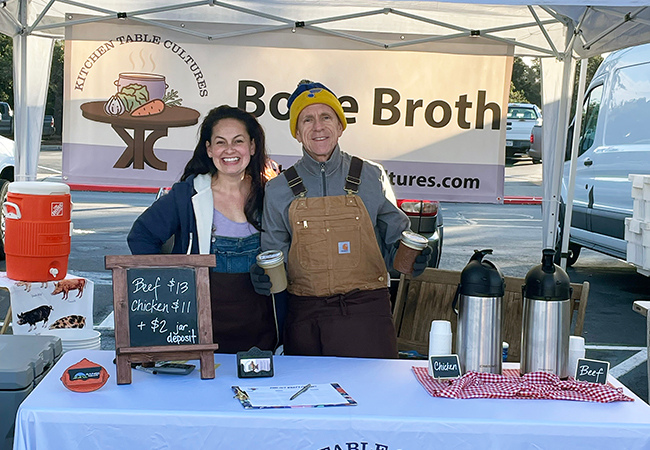
A wise friend once told me, “Eat your food as medicine, or you may find yourself taking medicine as food.” That message is close to the heart of Andrew Renard and Michelle Carter of Kitchen Table Cultures, local makers of bone broth and other traditional foods.
Andrew explains it this way: “Bone broth is made by slowly simmering animal bones—often with joints and connective tissue—until the liquid becomes rich in collagen, gelatin, and minerals.” When collagen cooks down, it turns into gelatin, which contains amino acids like glycine and glutamine. These compounds have been studied for their role in supporting a healthy digestive tract, helping food move smoothly through the gut, and contributing to overall resilience.
Bone broth has long roots in traditional diets across cultures. Andrew first encountered it while working at Three Stone Hearth in Berkeley, a kitchen inspired by the early nutrition research of Dr. Weston A. Price. In the 1920s and 30s, Dr. Price traveled the world studying traditional diets, observing that communities largely untouched by industrial foods enjoyed remarkable health. He identified “nutrient-dense” foods—like bone broth—as cornerstones of these diets.
Kitchen Table Cultures carries that philosophy forward today, sourcing bones from trusted ranchers who raise grass-fed, grass-finished animals. As Andrew likes to put it, these animals “only had one bad day in their life.” By using the whole animal, their broth honors both sustainability and flavor.
Beyond Gut Health: A Versatile Kitchen Staple
Bone broth isn’t just about digestive support. It’s a gentle source of protein, provides minerals such as calcium and magnesium, and contributes compounds that may support healthy joints. Many parents find it a nourishing choice for children, especially during growth years.
But perhaps the most immediate benefit is its versatility. Bone broth is delicious sipped warm from a mug, but it also shines as the base for seasonal cooking. In fall and winter, it’s the foundation for hearty soups, stews, and grains. Using a high-quality broth gives everyday cooking a layer of richness and depth that water or store-bought stock simply can’t match.
Tallow: A Traditional Cooking Fat
Alongside their broths, Kitchen Table Cultures also offers tallow—a traditional cooking fat rendered from beef. Tallow was once a staple in home kitchens for frying, roasting, and baking. It’s valued for its stability at high heat and for carrying fat-soluble vitamins. While nutrition experts debate the role of saturated fats in modern diets, many cooks appreciate tallow in moderation for its flavor and connection to traditional foodways. Try using it to roast seasonal vegetables, sear meats, or add depth to a pot of winter soup.
Bringing Tradition to the Modern Table
In today’s fast-paced world of grab-and-go meals, bone broth invites us to slow down, nourish ourselves, and connect with traditional cooking practices. Whether you sip it straight, serve it to growing kids, or ladle it into a hearty fall soups, Kitchen Table Cultures’ bone broth is a reminder that good food is often the best medicine.
You’ll find Kitchen Table Cultures at the farmers market this season—perfect timing as we lean into cozy, nourishing foods for fall and winter. Stock up, simmer a pot of soup, and taste the difference that begins at the kitchen table.
Click here for delicious fall and winter soup recipes on our companion website, Edible Paradise.
To learn more about Kitchen Table Cultures, visit their website, and be sure to stop by and say hello to Andrew and Michelle at the farmers market!